
How to Write Emails Faster Without Sounding Rushed
A simple structure that helps you stay consistent without staring at a blank screen


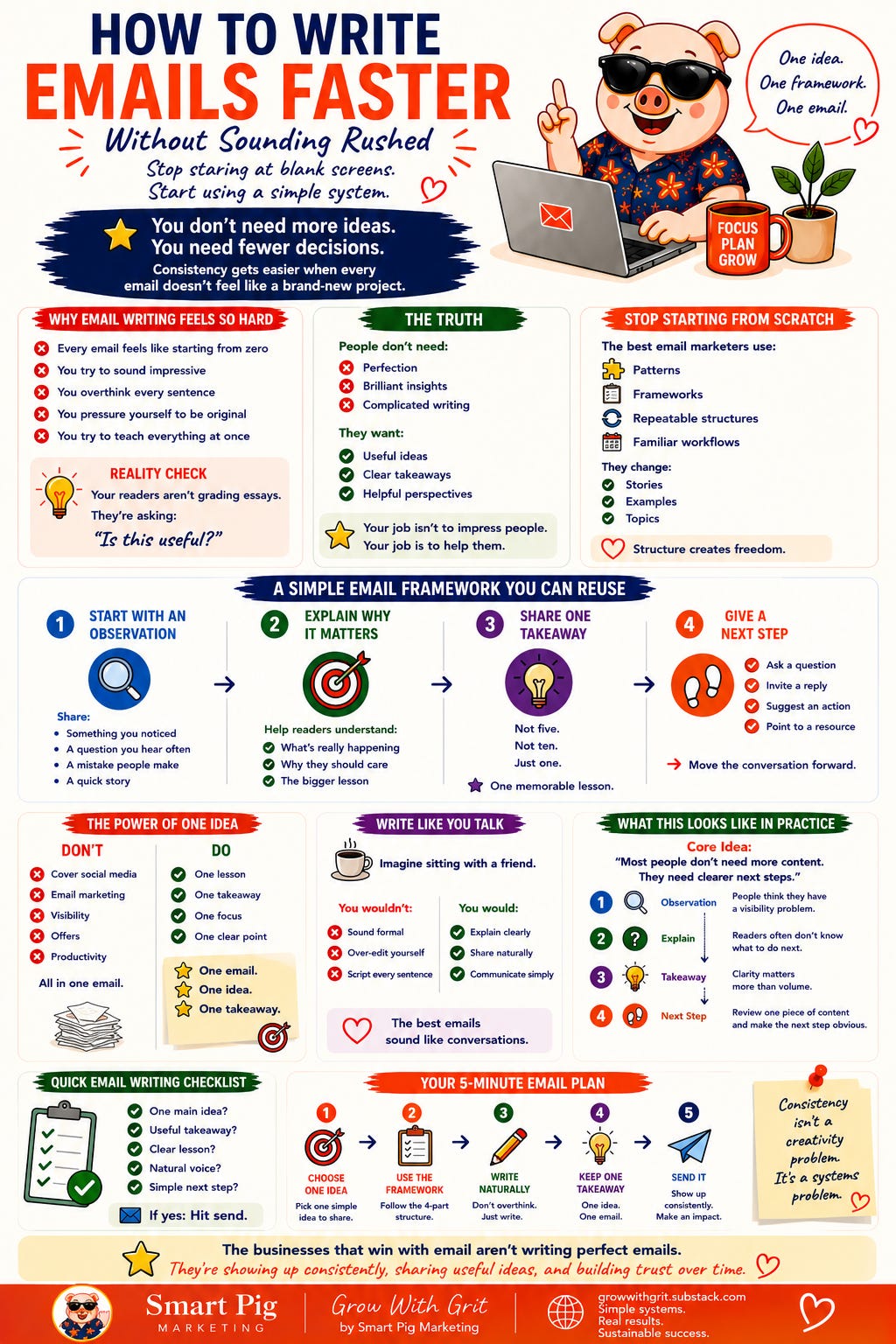
One of the biggest misconceptions about email marketing is that experienced business owners somehow sit down and effortlessly write great emails in fifteen minutes.
For most people, that isn’t what happens at all.
What usually happens is that they open a blank document, stare at the cursor, and start asking themselves a long list of questions. What should I talk about today? Is this interesting enough? Have I covered this topic before? Should I tell a story? Should I teach something? Is this too short? Is this too long?
By the time they’ve answered all those questions, they are already exhausted.
The problem isn’t usually a lack of ideas. Most business owners have far more ideas than they could ever use. The real challenge is that every email feels like a brand-new project. Every send feels like starting from zero. That creates friction, and friction is often what prevents consistency.
The good news is that email writing gets dramatically easier when you stop trying to reinvent the wheel every time you sit down to write.
Why Email Writing Feels So Hard
Many business owners unknowingly make email more difficult than it needs to be.
They assume every email needs a fresh angle, a brand-new lesson, or some brilliant insight that has never been shared before. They put pressure on themselves to be entertaining, educational, inspiring, and persuasive all at the same time. As a result, a simple email turns into a complicated writing project.
The irony is that your subscribers aren’t expecting perfection.
Most people open email because they’re looking for something useful. They want an idea, a lesson, a shortcut, a solution, or a perspective that helps them move forward. They are not evaluating your work like an English teacher grading an essay. They are simply asking themselves whether the email is worth their time.
When you remember that, email becomes much easier to write.
Your job is not to impress people.
Your job is to help them.
Stop Starting From Scratch
One of the reasons experienced email marketers can write quickly is that they rarely start from scratch.
They use patterns.
The topic changes. The examples change. The stories change. But the overall structure remains surprisingly consistent.
Think about your favorite television show. Every episode is different, but the basic framework stays the same. The familiarity makes it easier for viewers to follow along.
Email works much the same way.
When you create a simple structure you can return to repeatedly, writing becomes faster because you aren’t making dozens of decisions every time you send a message. You already know where you’re starting, where you’re going, and how you’ll get there.
The structure does not limit creativity. It creates freedom by removing unnecessary complexity.
A Simple Email Framework You Can Use Again and Again
If you’re looking for a place to start, try this four-part framework:
Begin with an observation, a problem, or a story.
This can be something you noticed while working with a client, a mistake you see people making, a question someone asked, or even an experience from your own business. The goal is simply to create a starting point that feels relevant and relatable.
Next, explain why it matters.
This is where you connect the observation to a bigger lesson. Help readers understand what is really happening beneath the surface. Give context. Show them why they should care.
Then share one key takeaway.
Not five takeaways. Not ten.
One.
The strongest emails are often built around a single idea that readers can easily remember after they’ve finished reading.
Finally, give readers a next step.
Ask a question. Encourage a simple action. Invite a reply. Point them toward a resource. The next step doesn’t need to be complicated. It simply helps move the conversation forward.
This framework works because it mirrors the way people naturally communicate. It feels more like a conversation and less like a formal marketing piece.
The Power of One Idea Per Email
One of the fastest ways to improve your emails is to stop trying to cover too much.
Many business owners worry that a short, focused email won’t provide enough value. As a result, they try to cram multiple lessons into a single message. They cover social media, email marketing, visibility, offers, productivity, and mindset all in one email.
The problem is that readers rarely remember any of it.
When too many ideas compete for attention, clarity disappears.
Think about the emails you remember most. Chances are they weren’t packed with dozens of tips. They usually contained one strong idea that made you stop and think.
A focused email is easier to write because you know exactly what you’re trying to communicate. It’s also easier to read because your audience isn’t working to figure out the main point.
One email.
One idea.
One takeaway.
That simple rule can dramatically improve both the writing process and the reader experience.
Write Like You Talk
Another reason email writing feels slow is that many people start writing in a voice they would never use in real life.
The moment they open a blank document, they switch into what I call “professional mode.” Every sentence becomes more formal. Every paragraph becomes more polished. They begin editing themselves before they’ve even finished writing.
Unfortunately, that often makes emails harder to write and less enjoyable to read.
The best emails usually sound like a conversation.
Imagine you’re sitting across from a friend at your favorite coffee shop. You’re sharing an idea, telling a story, or explaining something you’ve learned. You wouldn’t carefully script every sentence. You wouldn’t worry about sounding impressive. You would simply focus on communicating clearly.
That’s the mindset that often produces the strongest emails.
Your subscribers don’t need a polished performance.
They need a real person with a useful idea.
A Practical Example
Let’s say your core idea is this:
“Most people don’t need more content. They need clearer next steps.”
Instead of trying to build an entire newsletter around that concept, you could create a simple email using the framework we discussed.
You might start by sharing an observation from your own business or from conversations with clients. Then you could explain how many business owners assume their problem is visibility when the real issue is that readers aren’t sure what to do next.
From there, you would share the takeaway: clarity often matters more than volume.
Finally, you might encourage readers to review one piece of content and ask themselves whether the next step is obvious.
That’s an entire email.
Simple.
Useful.
Focused.
And most importantly, it doesn’t require hours to create.
Your Action Step
Before you write your next email, create a simple structure you can use repeatedly.
It doesn’t have to match the framework in this article exactly. The goal is simply to remove some of the decisions that slow you down. When you know how you’ll begin, where you’ll place the lesson, and how you’ll end, the writing process becomes much smoother.
Then choose one idea and build an email around it.
Not three ideas.
Not ten.
Just one.
You may be surprised by how much easier email becomes when you stop trying to create something completely new every time.
Why This Works
Consistency is rarely a creativity problem. More often, it’s a systems problem.
When writing feels difficult, we naturally avoid it. When writing feels simple, we do it more often. That’s why a repeatable structure can have such a powerful impact on your email marketing.
The businesses that succeed with email aren’t necessarily writing the most brilliant messages. They are showing up consistently, sharing useful ideas, and building trust over time.
And that becomes much easier when you stop starting from scratch every time you hit “compose.”