
A Simple Conversion Path You Can Set Up This Week
Turn attention into action with a clear, repeatable flow

Why Attention Alone Isn’t Enough
A lot of people are doing the hard part right. They are showing up consistently, creating thoughtful content, and sharing ideas that genuinely help their audience. Posts are being read, emails are being opened, and there are clear signs that people are paying attention. On the surface, it looks like everything is moving in the right direction, which is why it becomes so frustrating when that attention doesn’t translate into subscribers, customers, or steady growth. The gap between effort and outcome starts to feel confusing, especially when it’s not immediately obvious what’s missing.
In most cases, the issue isn’t the quality of the content or the value being delivered. The issue is what happens after someone engages with it. Every time someone reads a post or opens an email, there is a quiet decision happening in the background about what to do next. If that next step isn’t obvious, people don’t pause to figure it out. They simply move on, not because they aren’t interested, but because continuing requires effort. Attention without direction creates a moment of engagement, but it rarely leads to meaningful action.
The Missing Piece: A Clear Path
It’s very common to build an online business in separate pieces without realizing it. You create content because you know you need visibility, you set up a lead magnet because it’s supposed to help grow your list, you send emails to stay connected, and you develop an offer to generate income. Each of these pieces can be useful on its own, but when they aren’t intentionally connected, they don’t create movement.
What’s missing is the path that ties everything together. A path turns individual efforts into a cohesive experience, guiding someone from one step to the next without requiring them to stop and think about what to do. Instead of leaving gaps between your content, your emails, and your offer, it creates a natural progression that feels easy to follow. When that path is missing, people don’t drop off because they aren’t interested. They drop off because they don’t know where to go.
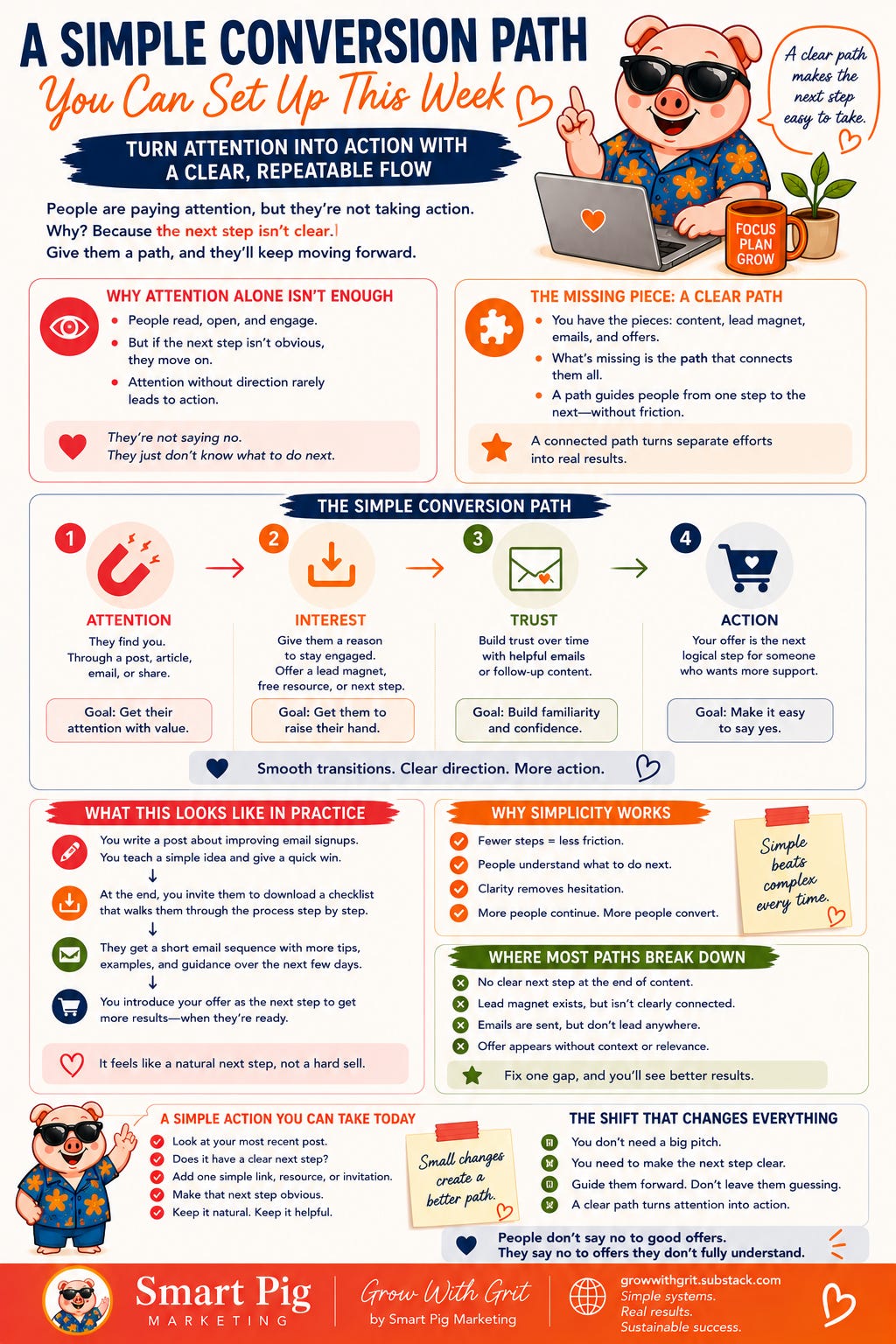
The Simple Conversion Path
At its core, an effective conversion path doesn’t need to be complex or technical. It simply needs to connect a few key stages in a way that feels natural and easy to follow. The first stage is attention, which is how someone finds you in the first place through a post, an article, or a shared piece of content. The second stage is interest, where you give them a reason to stay engaged by offering a deeper resource, a lead magnet, or a clear next step that builds on what they just consumed.
The third stage is trust, which develops over time as you continue to show up with useful ideas through emails or follow-up content. This is where familiarity and confidence start to build, making your message feel more reliable and your guidance more credible. The final stage is action, where your offer naturally fits into the flow as the next step for someone who wants more support. When these stages are connected, the transition from one to the next feels smooth rather than forced, and people are far more likely to continue moving forward.
What This Looks Like in Practice
A simple example makes this easier to see. Imagine you write a post that explains how to improve email signups. The post is clear, helpful, and gives the reader something they can apply right away. At the end of that post, you include a short, natural invitation to download a checklist that walks them through the process step by step, giving them a deeper way to engage with the idea.
Once they download it, they receive a short sequence of emails that expands on the concept and reinforces what they’ve learned, keeping them engaged over the next few days. During that time, they begin to recognize your voice, understand your approach, and feel more confident in what you’re teaching. When you eventually introduce an offer that helps them implement this more fully, it doesn’t feel like a sudden shift or a hard sell. It feels like the next logical step in a process they’ve already started, which makes the decision easier and more natural.
Why Simplicity Works Better Than Complexity
There is a natural tendency to overbuild when thinking about conversion. It can feel like adding more steps, more tools, or more layers will create better results, but in reality, every additional step creates another opportunity for someone to hesitate or stop. When the path becomes harder to follow, fewer people make it all the way through, even if the offer itself is strong.
A simple path works because it reduces friction at every stage. When someone can understand what to do next without thinking about it, they are far more likely to take that step. Clarity removes the small moments of hesitation that break momentum, and those small moments are often what determine whether someone continues or leaves. The goal is not to build something impressive. It is to build something easy to follow.
Where Most Conversion Paths Break Down
Most conversion paths don’t fail in obvious or dramatic ways. They fail quietly, through small gaps that are easy to overlook but powerful enough to stop movement. A post might end without a clear next step, leaving the reader without direction. A lead magnet might exist, but it isn’t clearly connected to the content that leads to it, making the transition feel disjointed.
Emails might be sent, but they don’t build toward anything specific, which weakens the sense of progression. An offer might be available, but it appears without enough context to feel relevant or timely. Each of these issues may seem minor on its own, but together they create a path that is difficult to follow and easy to abandon. Fixing even one of these gaps can create a noticeable improvement, because it helps more people continue moving forward instead of stopping along the way.
Build Your Simple Conversion Path (In 10 Minutes)
If you want to turn this into something real, the goal isn’t to design a perfect system. It’s to map what you already have in the simplest possible way and make one improvement.
Start by identifying where people first find you. This is your entry point, and it should be clear enough that you can describe it in one sentence. For example, your main entry point might be your Substack posts or a specific platform where you consistently share content.
Next, look at what happens immediately after that first interaction. Once someone reads your post or engages with your content, what is the very next step you want them to take? This could be joining your email list, clicking through to a resource, or simply reading another piece of content that builds on the same idea.
From there, consider how you stay connected. If someone takes that next step, what happens after that? This is where trust is built, whether through a welcome sequence, regular emails, or consistent follow-up content that keeps the conversation going.
Finally, look at where your offer shows up. At what point do you introduce what you sell, and does it feel connected to everything that came before it? When the offer appears in the right place, it feels like a continuation instead of a jump.
Once you’ve mapped this out, ask yourself one simple question: is there a gap where things stop or become unclear? You don’t need to fix everything at once. Your goal is to improve one step so that the path becomes easier to follow from start to finish.
The Shift That Changes Everything
When attention is random, results will always feel inconsistent and unpredictable, no matter how much effort you put into your content. When attention is guided through a clear path, results begin to stabilize because people know what to do next and how to move forward without hesitation.
A well-designed conversion path doesn’t rely on pressure or persuasion to work. It works because it supports the way people naturally make decisions, giving them clarity, reducing uncertainty, and making action feel simple. People don’t convert because they are convinced in a single moment. They convert because the path makes sense, and when it does, taking the next step feels like the obvious choice.